White House
Deception PointThe White House is both the seat of presidential power and the novel’s stage for converting hidden decisions into public consequences. Its Oval Office, communications facilities, corridors, and Briefing Room give political authority a physical form: secrets are guarded in one room, contested in another, and finally carried before the world through a presidential broadcast. The contrast between its controlled interior and the media audience outside makes the building a central setting for the struggle over NASA, credibility, and truth.
A guarded center of government
The White House is presented as a densely protected workplace as well as a residence. Even after three and a half years in office, Zach Herney does not usually feel at home amid its chandeliers, antiques, and armed Marines. Yet when he walks toward the West Wing in an unusually buoyant mood, staff members greet him with forced smiles, registering the tension that political triumph cannot dispel. His familiarity with the people around him, including a cheerful greeting to his secretary Dolores, gives the formal setting a lived-in texture without diminishing its security and ceremony.
The novel distinguishes the building’s rooms by the kinds of power exercised in them. The Oval Office is a site of private presidential authority: Herney sits behind the desk once used by Harry Truman, a daily reminder that responsibility for his administration’s shortcomings ultimately rests with him. Elsewhere, the White House Communications Office disseminates press releases prepared in the Communications Bullpen, turning internal decisions into messages for public consumption. The Briefing Room is where that managed communication becomes a national event, under media lights and before an audience reached by television, radio, and online news.
The White House’s security and internal organization also shape what can be communicated, and when. Its telephone switchboard is on the lower level of the East Wing, where operators manage calls among the building’s offices. Before televised briefings, cellular phones in and around the Briefing Room are switched off to prevent interruptions. When an urgent call cannot be patched through to the Oval Office because Herney is already headed to speak, the building’s communications apparatus becomes a point of vulnerability: a warning exists, but the presidential broadcast is already in motion.
Rachel and the politics of access
Rachel Sexton’s relationship to the White House begins through her intelligence work, not presidential patronage. Her father, Senator Sedgewick Sexton, publicly characterizes her position as a fairly low-level intelligence-community job: she compiles intelligence reports and sends them to the White House. He even asks whether she has met the President, emphasizing the distance between her routine liaison role and the institution’s highest office. That distinction becomes unstable when Herney seeks her assistance on a matter with immediate political stakes.
Before meeting Rachel, Herney recognizes the suspicion her recruitment could provoke. He expects William Pickering to have warned her that the President might be trying to use her for political advantage. Their encounter therefore begins with the question of whether access is a professional request or an instrument of presidential strategy. The novel places Rachel inside a chain of institutions in which information travels upward, while the reasons for a request may remain concealed from the person asked to act.
When Herney contacts Rachel by videophone, the distance between her and Washington, D.C., is made explicit: she is inside a large metal box three thousand miles away, yet the clear image and nearly seamless audio make the President seem close at hand. The screen first displays the White House seal before resolving into Herney’s face. Later, Rachel’s view opens onto a crowded Oval Office, where the entire White House staff appears to be watching her from the apparent vantage point of the President’s desk. Addressing them as the intelligence liaison to the White House, she speaks from an image of presidential authority while physically remaining far from the room. The scene makes institutional access both immediate and disorienting: a remote intelligence officer is suddenly required to brief the people who govern the institution receiving her reports.
Herney’s account of the political atmosphere inside the building further complicates the idea of unified executive control. He tells Rachel that only a few top advisers know about the discovery and that preserving its secrecy has been a priority. At the same time, he describes his staff as being in full-scale mutiny over his refusal to cut NASA funding. His credibility within the White House, he says, has suffered, and ignoring the demand has been political suicide. The building thus contains not a single presidential voice but competing advisers, institutional interests, and judgments about the costs of his policy.
Campaign conflict and controlled publicity
Outside the White House, the NASA dispute has already become a campaign struggle. Sedgewick Sexton has attacked the agency’s failed missions and enormous budget overruns, making NASA a prominent example in his argument against government spending and inefficiency. The White House is the institutional center of the conflict, but its consequences extend into the election: NASA’s fortunes and the President’s credibility are bound to public judgments about spending, discovery, and political advantage.
Herney’s planned announcement gives that conflict a fixed time and a public stage. He tells Rachel that he will hold a White House press conference at eight that evening to announce the discovery to the world. The declaration is kept secret from all but a small circle of advisers, yet the public presentation is prepared on a scale designed to reach beyond the building. The White House Press Office’s targeted publicity creates a wave of attention, while the Briefing Room concentrates the press and the presidential message into one televised occasion.
The broadcast also exposes the tension between message control and events that resist it. As Herney prepares to take the stage, he sees Marjorie Tench arguing heatedly on a cordless phone beside a White House operator whose face is pale with apprehension. He cannot hear the conversation, but its unusual urgency catches his attention. Meanwhile, the operator has tried and failed to connect an urgent call to the Oval Office; Herney is already on his way to the press conference. Behind the public spectacle, the building’s own corridors carry signs that the carefully scheduled announcement may not proceed on the terms its organizers intended.
The consequences of the announcement are immediately framed in electoral terms. A television analyst describes the claimed discovery as a triumph for Herney and NASA, and says it would revitalize the President’s campaign regardless of Sexton’s stance. Because Sexton has admitted he would go so far as to abolish NASA funding, the analyst calls the announcement a political blow from which the senator may not recover. The White House Briefing Room is therefore not merely a venue for scientific news; it is where a claim about discovery becomes an argument about leadership, public spending, and the candidates’ competing positions.
Secrets, accountability, and the final return
The building’s symbolism of executive responsibility is sharpened by the Truman desk in the Oval Office. Herney regards it as a reminder that the responsibility for his administration’s failures stops with him. That principle is tested by the meteorite deception. When Rachel faxes evidence from the Goya, William Pickering warns that its release could make the White House and NASA appear complicit and provoke an enormous backlash. He insists, however, that Herney and NASA know nothing of the deception and believe the meteorite is authentic. The distinction between apparent responsibility and actual knowledge becomes crucial: the White House may bear public consequences even where its occupants are not the authors of the secret.
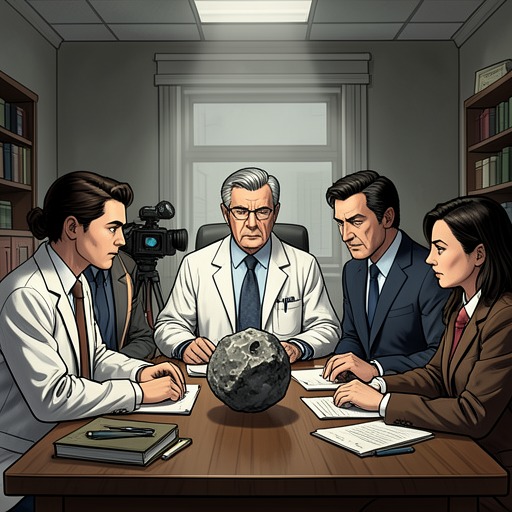
A flashback to a White House meeting two months earlier places the struggle over secrecy within a broader security debate. Around a long oak table sit members of the National Security Council, the Joint Chiefs, the CIA, Herney, Pickering, and NASA administrator Lawrence Ekstrom. Herney acknowledges damaging leaks and says the government is again considering tighter NASA security. He then challenges Pickering over the intelligence community’s willingness to spend a substantial portion of the black budget on a Mars mission with no immediate national-security benefit. The meeting shows the White House not simply as the source of orders but as a forum where civilian priorities, intelligence funding, and NASA’s security claims collide.
The residence also figures in the novel’s contrast between political crisis and ordinary domestic protection. On the night of the FDR Memorial bombing, Herney is preparing for bed less than two miles away, behind the residence’s inch-thick Lexan bulletproof windows. He does not hear the blast. The secure private quarters shield him from the immediate sound of an event unfolding nearby, while the broader political consequences remain inescapable.
By the final presidential broadcast, the White House has become the place where concealed claims must give way to candor. In the dark Oval Office, lit by a brass lamp on Herney’s desk, Gabrielle Ashe stands before the President; later, she accompanies him toward the Briefing Room, where crowds have gathered for a second special broadcast within twenty-four hours. Herney tells her that there is no substitute for the truth. The scene brings the building’s two functions together: the Oval Office as the setting for personal reckoning and the Briefing Room as the instrument through which an account reaches the public.
The White House’s closing role is also one of recovery. After the survivors are brought from the Washington Monument by a Coast Guard helicopter at Herney’s command, Rachel, Michael Tolland, and Corky Marlinson are taken to the building. They receive breakfast, medical attention, and the offer of one of its fourteen bedrooms in which to rest. The same institution that has served as the guarded center of a political crisis becomes temporary shelter for those who have endured its consequences. Its significance rests in that double image: a seat of power that can conceal, broadcast, and answer for events, and a physical place where exhausted survivors are finally cared for.